
Your Body Knows Before Your Mind Does
what a nanosecond nearly taught me the hard way

I was standing aft, near the roller, watching the net go out.
This is ordinary work on a gillnetter. The net deploys through the rollers, the boat pulls away, the corkline plays out behind you. You know your position. You know your job. You’ve done this enough times that your body moves without much conversation from your brain.
What I hadn’t tracked was the greenhorn.
His job was simple: when the end of the corkline came through, there’d be a six-fathom tow line clipped to a 24-inch buoy. Toss it clear of the jets, clear of the boat. Simple enough that you hand it to the new guy.
He tossed it — but not through the roller horns.
The buoy line, now moving fast with thousands of pounds of net pulling it away from the boat, was wrapped around my body.
What happened next I still can’t fully explain.
I didn’t think. There wasn’t time to think. The deckboss couldn’t have reached me. The skipper couldn’t have slowed the boat. There was no version of this where someone else solved the problem in the time available.
My body went limp. I collapsed to the deck. The line cinched up and the buoy flung hard around the horn and went overboard.
I lay there for a second. Heart hammering. Net already fifty yards behind us.
The thing that surprises me, even now, years later, is the precision of it. Not the speed — speed I could attribute to adrenaline, to reflex. What I can’t explain away is the accuracy. My body had done some complex calculation: the geometry of the line, the velocity of the boat, the behavior of the buoy, the position of the horn, what the deckboss could and couldn’t do, what the skipper would or wouldn’t have time for. All of it. In what felt like no time at all.
And then it acted. Before I’d formed a single conscious thought.
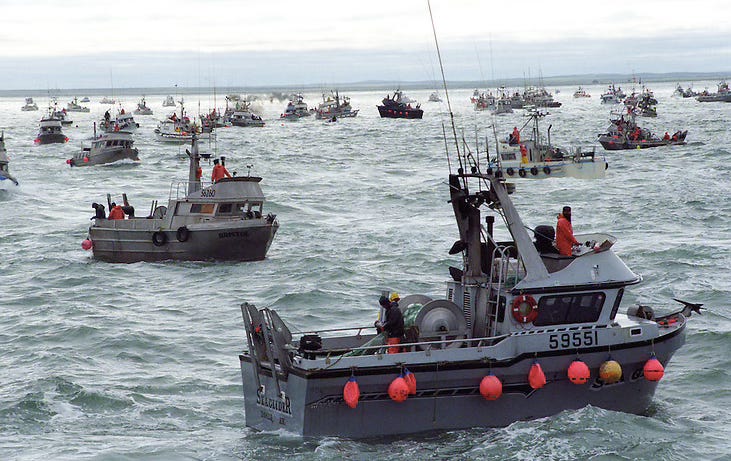
I don’t think every situation calls for that kind of response. Most of life isn’t a fishing deck with a line around your ribs.
But I do think most men are leaving something on the table by routing everything through their thinking minds first.
There’s a cost to that. Not always dramatic. Usually quieter.
I’ve been spending a lot of time lately in tools like this one — AI, content production, building things in the cloud. I’m someone whose value system is tactile. Woodworking. Lines. Physical tools in my hands. The feedback is immediate: the wood resists, or it doesn’t. The joint is square, or it isn’t. Your body knows.
The cloud doesn’t work that way.
And I’ve noticed something when I spend too many hours up there: a kind of dizziness. A low-grade lostness that coexists with a lot of focus. I can be highly productive by most measures and still feel like I’ve drifted from something real. Like I’ve been thinking very hard in a place that has no ground under it.
I wonder if that’s familiar to anyone reading this.
Because when I work with men, what I see most often isn’t a lack of effort or attention. It’s men who are very focused, very capable, very much in their heads — and quietly unmoored from the deeper layer of intelligence that actually knows what’s aligned, what’s off, what needs to happen next.
The body tracks things the mind doesn’t have language for yet. The slight tension before a conversation goes wrong. The drop in the gut when an agreement doesn’t feel right. The steadiness that shows up, unbidden, when you’re doing work that actually fits you.
Most men override that signal. Not because they’re stupid. Because the override gets rewarded. Fast answers, clear outputs, demonstrable progress — these are what the world pays for.
The body’s signal is slower. Quieter. Harder to bill.
But it was right on that deck in a way my thinking mind never could have been. And in my experience, it’s right more often than we give it credit for.
Nothing to do here except a question to sit with:
When was the last time you acted from your body’s knowing rather than your thinking mind — and it turned out to be exactly right?
You probably don’t have to go back very far.
This really resonated with me.
There’s a kind of intelligence that lives below the level of language. Moments like the one you describe remind us that the body is not just a vehicle for the mind, it’s part of the mind’s deeper awareness.
Your story on the deck captures something many of us forget in more abstract work: thinking is only one form of knowing. Sometimes the clearest signal arrives as a tightening in the gut, a stillness in the chest, or a sudden movement before thought catches up.
Reading this, I was reminded of an old Buddhist idea: the mind is not just what we think, but the whole field of awareness through which experience moves. When we’re grounded in that, action can arise naturally without the usual noise.
Beautiful reflection.
Stay entangled, my friend.
—The Bathrobe Guy
I think it was skiing. A friend told me he had to get stitches in his knee because he came down this trail and hit a patch of gravel and went down. So what did I do? I dropped off my kids at school and headed up the same trail just me and my dog. It had been too long since I’d gone fast on skis. I was careful at the spot where my friend had crashed. But on the next hill, I still felt that need for speed, so I let my skis drop into a packed truck rut where the snow was polished and faster. And thinner. I double poled and got going pretty good and then one ski caught gravel, but I was expecting it just enough to shift weight to the other ski, and luckily that ski didn’t catch gravel too, and I stayed on my feet and steered into the deep slow snow on the side of the road.
I used to do that a lot more, put myself in situations that forced me to shut down the thinking mind, skiing, climbing, mountain biking. Now it’s not often that I make time for it. Except in Bristol Bay, like you talked about. I feel lucky to have a job, even if it’s only just over a month a year, where I’m forced to follow my gut. Both to stay safe and to find fish. Just about counting down the days to the Bay now.
Reading your piece though, the first thing that came to mind was writing. How some of my stories that people loved the most were the ones that I just let spill, proofread, and post, with little or no revision. It feels good, plus the way the world is, half of what I write feels obsolete after a week. So thanks for inspiring me to get it out there a little rawer.