
Self-Mastery: your bilge pump needs attention
on burnout, flooding, and finding equilibrium

Flooding and Burnout are nervous system capacity issues that run on different time horizons. Flooding is a stress response engaged when you’re overwhelmed in a moment. Burnout is a long-term drain of capacity and meaning. (I talked about burnout in a recent post.)
The problem: without knowing how to turn off your stress response, you can remain flooded — feeling like you’re in survival mode — for days, weeks, months, or years. Which leads to deep burnout, and worse.
Most boats take on water. It slowly accumulates in the bilge in engine rooms, lazarettes, seeping through sealed penetrations. Depth finders. Stuffing boxes for the rudder or prop. Hull damage from running over rocks or set-net anchors in the shallows.
That’s why boats have bilge pumps monitoring water levels in the lowest parts of the vessel, automatically pumping it overboard when it reaches a certain level.
But when bilge pumps fail due to electrical failure, sensor failure, lack of maintenance, or when a sudden rupture causes an influx that overloads the pump’s capacity, things compound quickly.
Too much water in the engine room causes mechanical systems to fail. When the deck is loaded with slippery fish, the shift in weight from waves causes a list —a continuous lean to port or starboard. Then water comes through uncapped scupper holes onto the deck, increasing the severity of the list.
What matters is when the skipper and crew become aware of the problem, and how quickly they act to bring the boat back to floating equilibrium.
We’ve all been flooded. During fights, getting fired or broken up with, parenting small children. Times when our nervous system overloaded with anger, fear, or shame, and it was hard to see beyond a few feet.
Feeling trapped. Dissociating. Making sudden or impulsive decisions that help us survive the moment but harmed relationships: stonewalling, pushing away (emotionally or physically), physically protecting yourself by putting up your arms, yelling, hitting, etc.
These are normal reactions when you’re actually under attack.
The challenge is discerning between the experience of feeling attacked and actually being attacked.
It can happen on boats too, when a crew member collapses in fear rather than motivates into action.
This is why training to build your nervous system capacity is so important.
Martial artists, commercial fishermen, athletes, police officers, and combat operators practice the same moves thousands and thousands of times so their bodies remember what to do in high-stakes situations.
So they can funnel internal resources to staying calm, present, open, and aware — while doing what’s necessary.

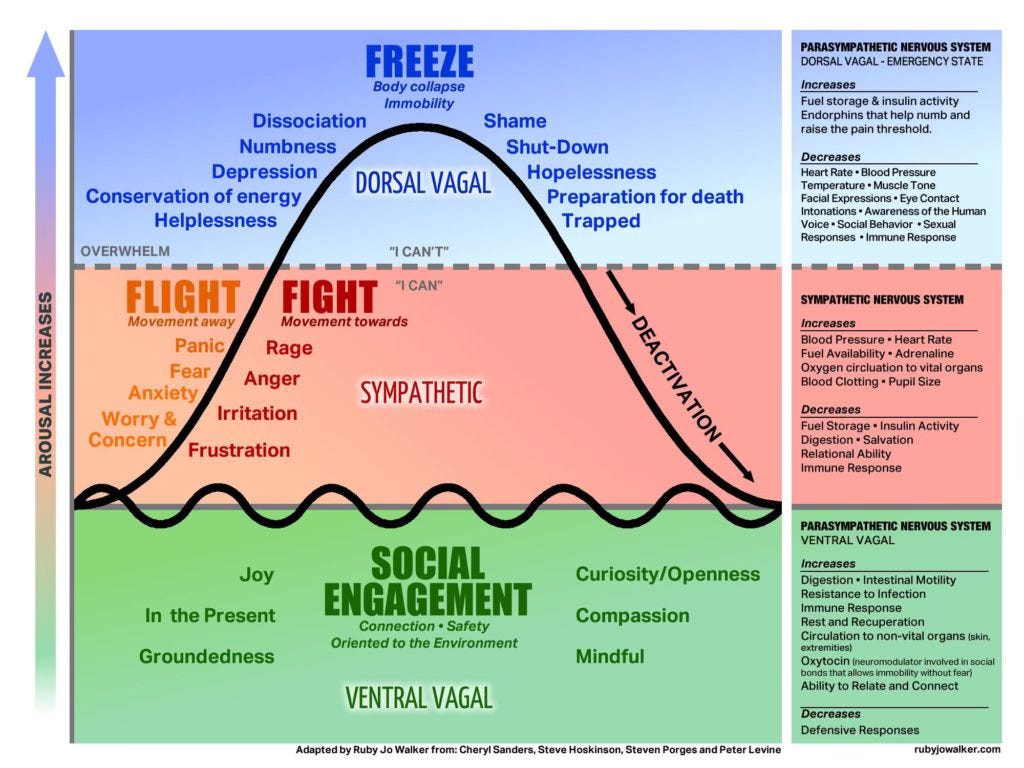
Early warning signs of flooding show up first as thoughts or impulses to self-soothe. This is too much. I need a cigarette. Physical signs include looking around, fidgeting, checking your phone, or arms crossing (crossing the midline helps regulate the nervous system and protects vital organs).
Physical sensations range from cold (dissociation, freeze state) to increased heart rate, short quick breathing through the mouth, narrowed vision and hearing, urgent thoughts.
Behaviors also range wildly, usually templated from how you’ve responded to “too much, too fast” in the past. Some of us get real big when danger approaches. Some get real small.
Those with a history of complex PTSD may notice a feeling that someone needs or is taking something from you. People who fawn or submit attempt to make everything okay to keep themselves or others safe.
In their original context, all of these are normal and effective human responses to overwhelming stimuli. Our brains developed over millions of years to protect us from death. A healthy amygdala is really quite helpful.
But when we’re activated all the time, problems arise. We think we’re in danger when we’re not. Over time, this experience can habituate us to look for evidence to prove we’re in danger.
Translation: if we never turn the stress switch off, or if it remains ON because we’re stuck in hypervigilance, we miss out on life. We’re reacting in this moment to something that happened potentially decades ago, unable to bridge the gap.
So what bridges that gap?
Conscious awareness. Sensing and registering a lack of threat. A feeling of connection, whether to the earth, to your own body, being touched or held by someone else.
You can slow your breathing: in through the nose, and long exhales signal the nervous system to calm down. Thoughts slow down. Things seem less loud or urgent in your head. Heart rate decreases if it was elevated, or returns to normal if you went somewhere else but remained physically present. More options seem available. Eventually, you reach baseline.
We don’t build nervous system capacity by exposing ourselves to threat.
We expand capacity by building a strong ground.
A strong ground creates spaciousness in the nervous system. You can feel support and resource available. Your lungs can take in more air. Your eyes can soften in focus. You find your way back to yourself, feeling the ground beneath your feet, the texture of your clothing, the temperature of air on your skin. You’re back in your body, in your life.
How do you practice spaciousness? Look ahead at your day. Are there moments when you can predict you might feel activated? Pay attention to any tension you notice. See if it wants to relax. Pay attention to your jaw, cheeks, brow, the backs of your eyeballs.
It may sound weird to pay attention to the backs of your eyeballs. Try it. Take a long, slow breath through the nose, and a slower exhale.
You might not get it the first time, or the thirty-fifth time. But the more you practice focusing awareness on different parts of your body and letting them relax at whatever pace feels right - again, practicing when you’re not flooded - the easier it becomes to access your core self in difficult moments.
There’s a classic awareness test many practitioners use to help people back to the present moment. You can use it to help others having a difficult moment.
What are five things you can see right now?
What are four things you can hear?
What are three palpable things you can feel?
What are two things you can smell?
Then stand on one foot for a few long, slow breaths.
The purpose: calibrate your sensory system to the present moment.
It’s also a tool I’ve used to help crew on fishing boats calm down and help us not die. It works best when the asker is calm themselves.
There was a day during my last season where more fish showed up than ever before. So much it became a problem for a lot of boats real fast. Everyone wants to catch a lot of fish, but not everyone’s prepared for when you actually do.
The nets sunk in the water. We had to pull them in hand over hand, thousands of fish coming over the roller so we didn’t accidentally get swept by the tide and cross an imaginary but real GPS line and receive a hefty fine.
The greenhorn got stuck under the pile of fish - stuck but safe for the moment. The engine room started taking on water. The boat was listing badly. The skipper was busy driving.
My only available crew was frozen in fear, sitting on the gunwale zoning out rather than bailing water out of the engine room.
I put my hand on his shoulder: Can you feel me here with you? Yes. Can you feel the gunwale rail under your butt? Yes. Can you hear the engine running? Yes. Can you feel your breath? No. I’m going to die.
You’re not going to die today, I said firmly, confidently. The skipper’s going to make sure of that.
Okay, he said.
What did you just hear me say?
I’m not going to die, he said, looking up.
Great, I said. I’m not dying today either. But I need your help. Are you willing to help me?
It worked. He kicked into a more helpful gear.
No humans died that day on our boat.
Awareness and action make all the difference. The goal is the same: returning to equilibrium. Nervous system regulation.
Flooding and burnout are both deeply uncomfortable experiences. People do what they can to avoid them.
Flooding happens when you can’t override anymore. The amygdala triggers a fear response like there’s danger present. The body automatically responds.
Burnout often begins as a result of denying there’s a problem over time. Overriding what the system needs in order to do a thing, complete a task, make money, fulfill the mission.
The way back home in the body looks the same for both, though the time horizon is different. Regulating the body after flooding can take hours, or less when there’s practice and support present. Recovering from prolonged burnout can take months or years.
You’re not broken. Your bilge pump just needs attention.
The bilge pump metaphor is brilliant for explaining flooding vs burnout. That fishing boat story where you talked the frozen crew member back into action really shows how awareness shifts everything. I've noticed the same thing with my own nervous sytem, once you can recognize early warning signs it's way easier to intervene before things spiral. The part about expanding capacity by building strong ground rather than exposing yourself to threat is counterintuitive but makes total sense.
We so often struggle to put how we feel into words. Conceptualising the mind is near impossible, and personally I don't find scientific language particularly helpful. Well crafted imagery like this is invaluable in seeing the mind clearly - and a huge source of comfort. A great read, thank you.